
You’ve been told a tooth needs a crown, and then comes the follow-up question: do you want it done in one visit, or the usual way over two? It sounds like a choice about convenience. It’s really a question about your tooth, and the honest answer starts with your dentist taking a proper look at it.
Here’s the short answer. The Australian Dental Association (ADA) says crown treatment often takes two appointments with your dentist, with a temporary crown in between. At West Perth Dental Centre, same-day crowns made with CEREC technology let eligible patients receive their crown in a single visit. Which route suits you depends on the tooth, your bite and your gums.
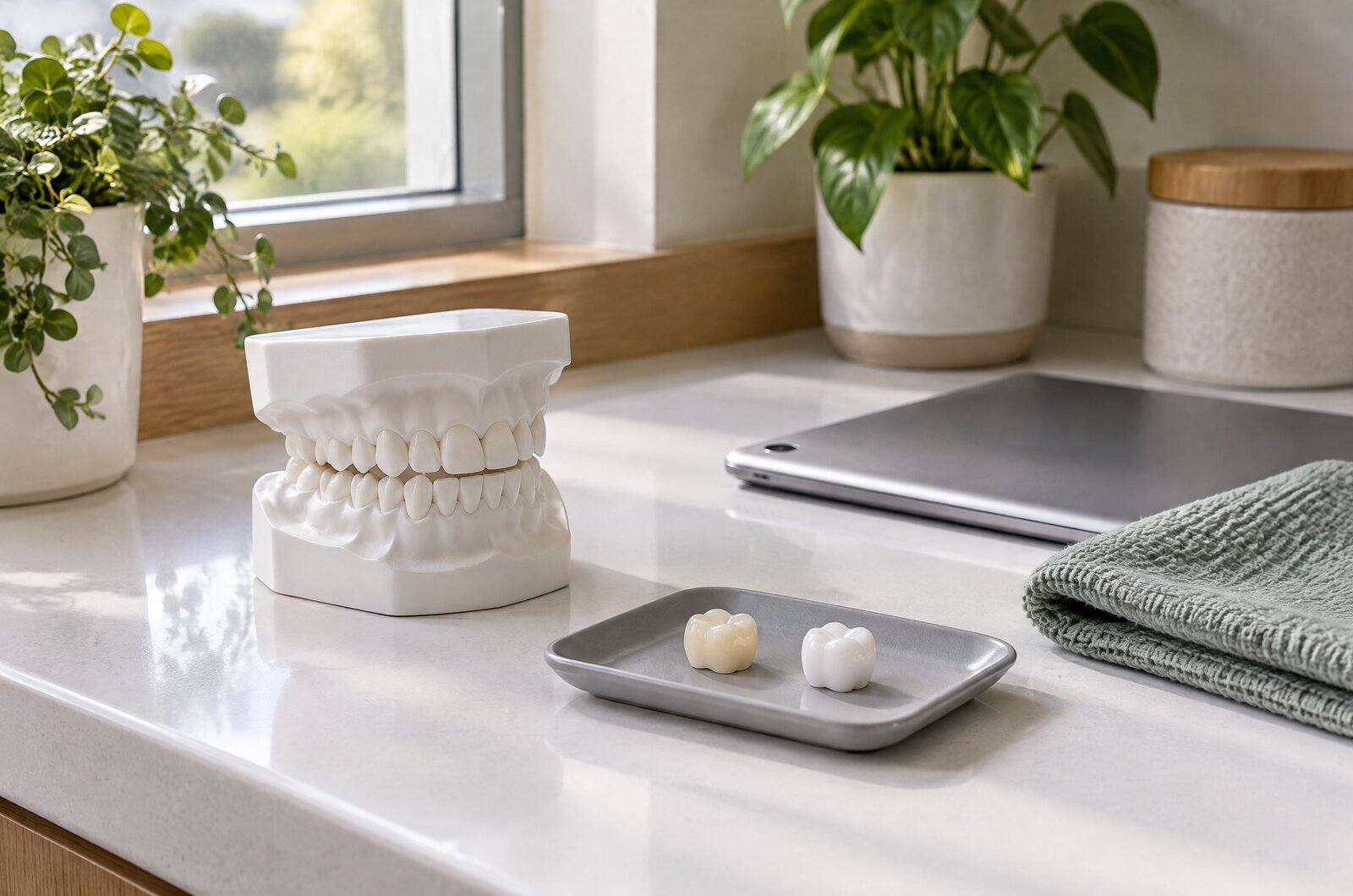
Top image: AI-generated illustration.
Summary of the Content
- A lab-made crown is made by a dental technician from an impression or 3D scan, then fitted at a second visit.
- A same-day crown is scanned, designed, milled and fitted at the clinic in one appointment, for suitable teeth.
- West Perth Dental Centre lists what decides suitability: how much healthy tooth is left, decay or gum disease, grinding and gaps between teeth.
- Your quote should show item numbers for the crown and any build-up or temporary crown, so you can compare like with like.
- Any crown still needs brushing, cleaning between the teeth and regular check-ups.
What Happens With a Lab-Made Crown?
The traditional route is the one most people picture. The ADA describes it in five steps:
- At the first appointment, the dentist will cut back the tooth to reshape it, to make sure there is enough space for a new crown to fit on the tooth.
- A copy of the tooth shape is taken, either with an impression (a jaw-shaped tray filled with a soft, gel-like material, held in place for three to five minutes) or with a digital scanner that takes a 3D image of the tooth.
- The impression or 3D image is provided to a dental technician who makes the crown. For a tooth-coloured crown, your dentist will work with the technician to ensure the colours and any special features match your other teeth as best as possible.
- Before leaving this first appointment, your dentist will put a temporary, plastic crown over the reshaped tooth.
- On the second visit, the temporary crown is removed and the new crown is glued or cemented onto the natural tooth structure.
The part people notice most is the gap in the middle. You live with a temporary crown for a while, and you come back for a second appointment.
The ADA also says crowns can be made from a number of materials, including porcelain, zirconia, gold alloy or a combination of porcelain and metal, and that the colour of porcelain and zirconia can be matched to the colour of your other teeth. Material is one of the things that shapes which route your dentist suggests, which is why it’s worth asking about.
How Does a Same-Day Crown Work at West Perth Dental Centre?
The ADA notes that some dentists now provide same-day crowns where treatment is provided from start to finish in one day. West Perth Dental Centre is one of them, and it describes its digital crown workflow in five steps:
- Scan. After your tooth has been assessed and prepared, a digital scanner captures detailed records of the tooth, neighbouring teeth and bite.
- Design. Your dentist uses digital design software to plan the shape and form of the crown.
- Mill. The crown is milled from a selected ceramic block using in-house digital milling technology.
- Finish. The restoration is finished and, depending on the material and workflow, may go through additional processing before it is ready to try in.
- Fit. Your dentist checks the crown against your tooth and bite before it is fitted, and adjustments may be made where needed.
The clinic names the equipment behind this: a Primescan intraoral scanner, CEREC design software, a Primemill in its in-house digital lab and, where required, the SpeedFire ceramic furnace. Its crowns are milled from ceramic blocks such as lithium disilicate or zirconia. Its same-day crowns page also says that creating your crown may take about 60 to 90 minutes, so ask the team how long to set aside for the visit.
Same-Day or Lab-Made: How Do They Compare?
| Lab-made crown | Same-day crown at West Perth Dental Centre | |
|---|---|---|
| Number of visits | Often two appointments (ADA) | A single visit for eligible patients |
| Temporary crown | A temporary plastic crown is worn between visits | No temporary restoration or second appointment |
| Copy of your tooth | An impression or 3D scan is sent to a dental technician | A digital scan, designed on screen at the clinic |
| Where it’s made | In a dental laboratory | Milled from a ceramic block in the clinic’s in-house lab |
| Materials | Porcelain, zirconia, gold alloy or porcelain and metal (ADA) | Ceramic blocks such as lithium disilicate or zirconia |
| When it’s used | Cases that need staged planning, laboratory stages or input from a specialist | Suitable single-tooth cases, after assessment |
Neither column wins on its own. They’re two ways of reaching the same goal, and the right one depends on the tooth in front of your dentist.
Who Might Suit a Same-Day Crown?
West Perth Dental Centre says same-day crowns are better suited to some than others, and that this will be determined based on your current oral condition. Its same-day crowns page lists what it looks for:
- Enough healthy tooth. For the crown to bond firmly, you need at least two millimetres of healthy tooth structure. The clinic describes this as one-quarter of the visible portion of your affected tooth.
- No significant decay or infection. A same-day crown may not be suitable if your tooth is significantly decayed or infected, because the crown must be firmly bonded to a healthy tooth.
- Grinding habits. Bruxism (teeth grinding) can damage the crown and weaken its bond. If you grind, your dentist may recommend a more durable material for the crown or a special mouthguard to protect it.
- Gaps between teeth. Same-day crowns can help address minor gaps, but they are unsuitable for more severe cases because the crowns may be too bulky and can affect your bite.
If you’re not sure whether you grind, that’s fine. It’s one of the things the assessment is for.
When Might Your Dentist Suggest a Different Route?
Sometimes the answer isn’t a same-day crown, and sometimes it isn’t a crown at all. West Perth Dental Centre’s MiCrown 5D page puts it plainly: a crown is not automatically the right answer for every damaged tooth. Before recommending treatment, your dentist will assess the tooth, gums, bite, symptoms, remaining tooth structure, existing dental work and likely alternatives.
For a heavily filled tooth, the clinic says your dentist can assess whether another filling, an onlay, a crown or another option may be appropriate. For more complex cases, its same-day page says treatment may require additional planning, further appointments, an external laboratory or input from a specialist.
The ADA’s description of when crowns come up is a useful guide too. A crown may be recommended by a dentist to fix a badly broken, cracked or decayed tooth, and crowns are commonly recommended for teeth that have had a root canal treatment, particularly premolar and molar teeth. West Perth Dental Centre adds that some root canal treated teeth may require cuspal coverage or a crown, while others may be managed differently depending on remaining tooth structure, bite pressure and clinical risk.
What Should Your Crown Quote Show?
Healthdirect says there are no standard fees for dentists like there are for doctors, and each clinic determines their own fees. Before you agree to treatment, it suggests you ask your dentist how much the procedure will cost, ask for the item numbers to compare prices, and ask whether there are less expensive alternatives.
Item numbers come from the ADA’s Australian Schedule of Dental Services and Glossary, which the ADA calls the definitive coding system of dental items and clinical procedures in Australia. These are some crown-related items you might see. The names come from the Department of Veterans’ Affairs dental fee schedule (effective 1 January 2026), used here for item names only:
| Item number | What it means |
|---|---|
| 613 | Full crown, non metallic, indirect |
| 625 | Core for crown including post, indirect |
| 631 | Provisional crown, per tooth (a temporary crown) |
You may also see an examination, X-rays or other items if they’re part of your plan. Ask which item number your crown will be billed under, and whether a build-up or a temporary crown is included or listed separately.
On paying for it, healthdirect says most dental care is not covered by Medicare. Crowns may sit under “major dental” in the extras part of a private health policy, and healthdirect notes that policies vary widely, with limits on how much you can claim each year. West Perth Dental Centre has a HICAPS terminal so you can process claims on the spot, and it suggests calling your health fund to check your cover before you book. The clinic also lists Afterpay, Zip, Humm and SuperCare among its payment options.
Your Crown Appointment Checklist
Take these questions with you. Tick them off as you go:
- Is a same-day crown suitable for this tooth? If not, what’s the reason?
- What material are you recommending, and why that one?
- Does the tooth need a build-up, core or post first?
- Will I have a temporary crown, and how should I look after it?
- Which item numbers are on my quote, and which ones should I check with my health fund?
- How long should I set aside for the appointment?
- Are there alternatives, such as a filling or an onlay?
- Do I grind my teeth, and would a mouthguard help protect the crown?
Looking After a Crown Afterwards
Whichever route you take, the ADA says teeth with crowns need to be well cared for to help them last as long as possible. Brush twice per day with fluoride toothpaste and clean between your teeth every day.
The ADA is also clear that having a crown does not mean no treatment will ever be needed again for the tooth. Crowned teeth can still be damaged by tooth decay, and crowns can chip, fracture or no longer match the colour of your teeth and need to be replaced.
West Perth Dental Centre describes ongoing care as including tailored cleaning advice, hygiene appointments, bite reviews, monitoring for decay or gum concerns, and discussion of a night guard or splint where clinically indicated. Its same-day crowns page says you may experience mild pain or discomfort and sensitivity after the procedure, which should go away within a few days. If it doesn’t, or your bite feels different, call the clinic.
Booking a Crown Assessment at West Perth Dental Centre
West Perth Dental Centre is at 39 Colin Street, West Perth. It’s open Monday to Friday from 8:00 AM to 8:00 PM (by appointment only) and Saturday from 8:00 AM to 1:00 PM. Dr. Michael Wu holds a Doctor of Dental Medicine degree from the University of Western Australia, and in addition to English he is fluent in Mandarin.
When you come in, bring your health fund card, a list of any medicines you take, and any recent X-rays or a quote from another clinic if you have them. Your first visit is the assessment: your dentist checks the tooth, your bite and your gums, then talks you through whether a same-day crown, a lab-made crown or something else suits it.
Call 08 9321 6928 or book an appointment online. If you’re not sure what to say, try: “I’ve been told I need a crown. Can I book an assessment to see whether a same-day crown would suit my tooth?”
Frequently Asked Questions
Is a same-day crown as strong as a lab-made crown?
West Perth Dental Centre’s same-day crowns page says that because they are made of ceramic, same-day crowns can be less durable and more prone to wear than traditional crowns that are made of porcelain or metal, so proper care plays a significant role. Your dentist can explain how that applies to the tooth being treated.
Does getting a crown hurt?
The clinic says these treatments are generally not painful because you will receive local anaesthesia to numb the area around your tooth, although you may feel pressure while your tooth is being prepared.
Can every tooth have a same-day crown?
No. The clinic says not every tooth is appropriate for same-day treatment, and some situations may benefit from additional planning, temporary restorations, laboratory stages or input from a specialist.
Final Thoughts
A same-day crown and a lab-made crown both aim to protect and restore a damaged tooth. The difference is in how the crown gets made and how many visits it takes. The deciding factors are the tooth itself: how much healthy structure is left, the state of your gums, your bite and whether you grind. Book an assessment, take the checklist with you, and ask your dentist to explain the route they recommend and why.
Written by Dr. Michael Wu, General Dentist, West Perth Dental Centre.
Sources
Checked 30 October 2026. This article explains general published guidance and the clinic’s own published information, not advice about your tooth.
- Australian Dental Association: Crowns, bridges and veneers.
- Australian Dental Association: Australian Schedule of Dental Services and Glossary.
- Department of Veterans’ Affairs: Fee Schedule of Dental Services, effective 1 January 2026 (item names only).
- Healthdirect: Cost of dental care (last reviewed October 2023).
- West Perth Dental Centre: Same-day crowns, MiCrown same-day digital crowns, MiCrown 5D, Payment options, Dr. Michael Wu and Contact us.
- Photos in this article are AI-generated illustrations, not photos of West Perth Dental Centre, its staff or patients.


 General Dentistry
 Cosmetic Dentistry
 Emergency Dentist
 Dental Implants
 Orthodontics
 Restorative Dentistry
 Trademarked Treatment
 Digital Dentistry